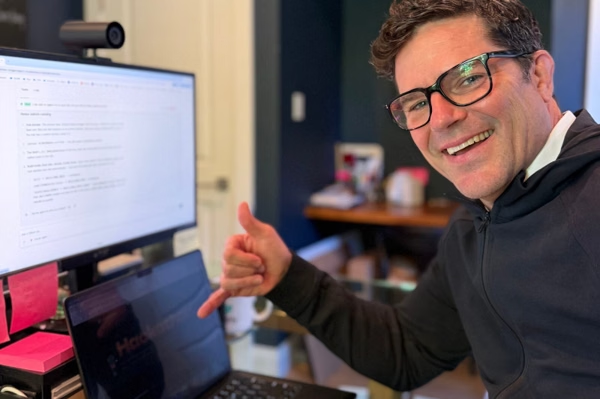
I was in Salt Lake City last week seeing customers, and spent some time with Tanner Linsley and Jonathan Hislop from TanStack.
The three of us and Sarah Mandel ended up talking for a long time about models, security, and skills.
TanStack is foundational to a huge number of apps being built right now. The models love it. We just redeployed our own agent using tooling from their latest release, and Jack Herrington on our team is deeply involved in the community.
Their sponsor list gives you a sense of how important the ecosystem has become: Lovable, Cloudflare, Vercel, CodeRabbit, Railway, Render, Netlify, and others.
But the part of our conversation that really stuck with me was about skills.
Tanner made a simple point:
"Someone can download something that looks like a TanStack skill, but that skill can have a whole bunch of other stuff embedded in it."
That's the problem.
As skills become mainstream, the people installing them increasingly won't be developers. They're not going to read the source code. They're going to see a familiar name, and trust what they're installing.
But do they know:
- Where the skill came from?
- Who maintains it?
- What access they just handed over?
- Whether the skill has changed since they installed it?
That's why the open source work Tanner and the TanStack team are doing matters. The easier it is to identify and maintain the trusted version, the harder it becomes for malicious or outdated versions to hide in plain sight.
I'm still telling everyone to install the Netlify skill.
Skills are incredibly powerful because they give an agent the current instruction manual instead of relying on whatever it remembers from its training data.
But I now think there's another question every company needs to ask:
Who maintains the skills our people are using, and how do we know when they change?
That's not just a developer question.
It's a governance question.
And very soon, it's going to be an enterprise question.